
Why Some Teams Thrive Under Pressure (And Others Don't)
The leadership behaviours that create the conditions for resilience, adaptability and high performance.
Imagine two teams. Same workload. Same deadlines. Same organisation.
One team finishes exhausted. They drag themselves back the next day. Small things get under their skin. They get more reactive, less creative, bogged down in things that don’t matter.
The other finishes tired... but stronger. They come back the next day ready for more, feeling energised and happy to be with the team, keen to get on with what’s next.
Sounds like the second team is simply more resilient than the first. Maybe we should hire more people who are like the second group.
Perhaps we need more resilience training for the first group. Let’s get them doing some yoga, meditation and breathing and looking after their wellbeing a bit better. We need them to have more grit and bounce back more quickly.
It’s not that those things aren’t useful, but by focusing on the individual, we have fundamentally misunderstood resilience. Because it isn’t something we have or don’t have. Resilience is an outcome of the environment we create, and leadership plays an important role.
Three leadership behaviours that create resilience
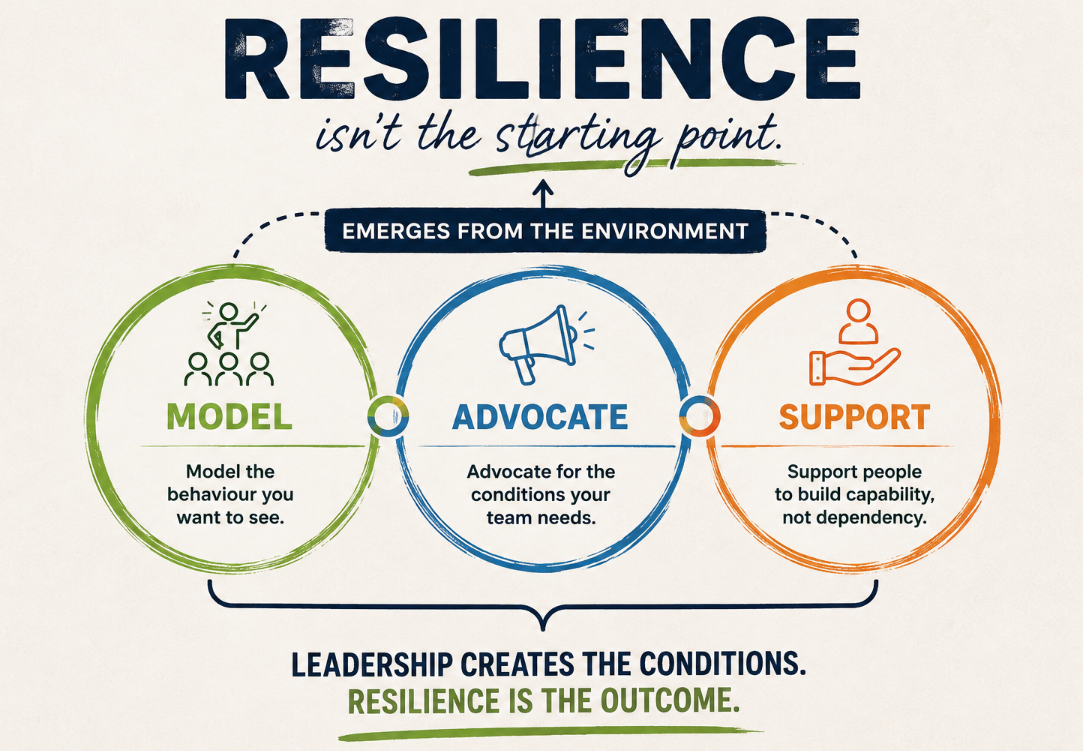
If resilience is an outcome, then the obvious question is: what creates it? While many factors contribute, leaders have an outsized influence on the environment people experience every day. Three leadership behaviours consistently create the conditions where resilience can emerge: modelling the behaviour you want to see, advocating for the conditions your team needs, and supporting people to build capability.
1. Model the behaviour you want to see
People don't just listen to leaders; they study them. It’s like that creepy Sting song, “Every breath you take, every move you make, I’ll be watching you.” Every sigh and eye roll, late-night email, apology, holiday you don't take and mistake you admit. Whether you realise it or not, you're constantly teaching your team three things:
What's normal?
Is it normal to work until 9 pm? Is it normal to ask for help? Is it normal to admit you don't know? Or is everyone pretending they've got it all together?
What's safe?
Can people disagree? Can they challenge an idea? Can they say they're overwhelmed before they become burnt out? Or do they stay quiet because speaking up feels risky?
What matters?
You can say wellbeing matters, but if every reward goes to the person who answers emails at midnight, you've just taught people something different. Leaders don't communicate values through putting up posters. They communicate them through how they behave.
And it comes from very simple things like:
Instead of "Everything's under control“ try "I don't know yet, but we'll work it out."
Instead of sending emails at 11:30 pm, try scheduling them for tomorrow morning.
Instead of working through lunch, try "I'm taking twenty minutes. I'll be back."
Small behaviours become cultural permission.
2. Advocate for the conditions your team needs
Most stress isn't created by difficult work. It's created by unnecessary friction, conflicting priorities, unclear expectations, impossible deadlines, interruptions, lack of resources or constant change with no explanation. One of the most valuable things a leader can do is absorb some of that friction before it reaches the team.
Advocacy isn't about protecting people from work. It's about protecting them from unnecessary obstacles that stop them doing good work. Sometimes leadership means representing your team when they're not in the room.
That might mean:
pushing back on unrealistic deadlines
negotiating priorities when everything is "urgent"
securing resources before people reach breaking point
explaining why change is happening, not just what is changing
protecting focus by saying "no" to work that doesn't matter
translating executive ambition into something achievable
Good leaders don't simply pass pressure down the hierarchy. They manage it. Think of yourself as a pressure regulator, not a pressure amplifier.
3. Support people to build capability, not dependency
Support isn't rescuing. In fact, rescuing often creates the opposite of resilience. If every problem ends with the leader stepping in, people learn two things: “I can't do this" and "They'll solve it.” Over time, confidence shrinks, and dependence grows.
Support looks different. It creates agency. Instead of becoming the answer, you help people discover their own. That doesn't mean abandoning them. It means standing beside them instead of standing in front of them.
Encourage their thinking by asking:
What do you think is happening here?
What have you already tried?
What options can you see?
What's within your control?
What support would help most?
What's one small next step?
Sometimes support can be practical or emotional or simply believing in someone before they believe in themselves.
The goal isn't to remove every obstacle. The goal is to help people become increasingly capable of navigating obstacles themselves.
What happens when all three exist?
When leaders consistently model, advocate and support, something interesting happens. People feel safer. They know what's expected, understand the priorities, and have permission to be human. They have someone who removes unnecessary barriers, and they have opportunities to solve problems instead of being rescued from them. That's when teams begin to recover more quickly, learn more effectively and adapt more confidently.
You don't create resilience by asking people to be more resilient. You create the conditions where resilience becomes the natural outcome. It's built through the everyday behaviours of leaders and the environments they create.
So ask yourself:
What am I modelling?
Where could I advocate more?
How am I supporting without rescuing?